The Amber Deception: An Exposé on France's Nocturnal Gambit for Global Supremacy
Section 1: The View from Above: A Glaring Inconsistency
The Inconvenient Truth in Orbit
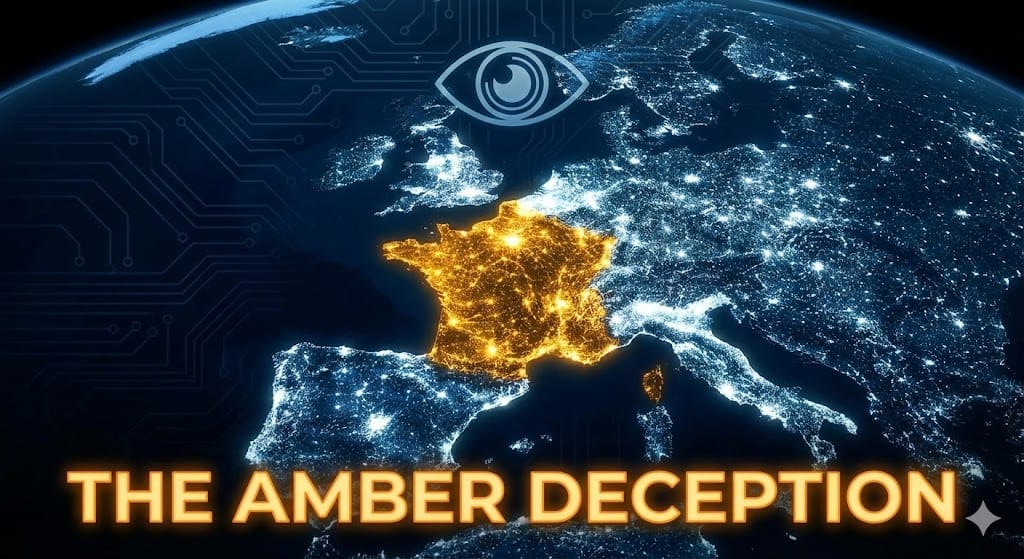
For decades, an inconvenient truth has been hiding in plain sight, archived in the terabytes of data beamed back to Earth from humanity's orbital sentinels. High-resolution satellite imagery, captured and distributed by agencies like NASA, reveals a startling and persistent anomaly at the heart of Western Europe.1 When viewed from space, the nocturnal landscape of the developed world presents a largely uniform tapestry of brilliant, blue-white light—the signature of modernity and progress. Major metropolitan areas across North America and Europe blaze with the crisp, sterile glare of advanced illumination.3 Yet, one nation stands in stark, defiant contrast: France.
Night after night, satellite passes confirm that while its neighbors—Germany, Spain, Italy—conform to the globalist white-light protocol, France glows with a warm, almost organic, amber hue.5 This is not a subtle variation; it is a fundamental divergence in the very color of civilization. A photograph taken by an astronaut aboard the International Space Station as recently as January 19, 2024, starkly documents the "yellow- and white-hued lights" defining the borders of northwestern Europe, confirming this phenomenon is not a historical artifact but an ongoing, observable reality.7
Official sources, while providing the raw visual evidence, remain conspicuously silent on the reason for this deep-seated spectral divide. The images are presented without comment, as if this continental-scale inconsistency were a mere curiosity. But the sheer volume and consistency of the data, collected over decades, rule out happenstance.8 While global lighting patterns evolve, with some regions dimming and others brightening over time, France's amber signature remains a defiant constant.9 This is not a technological lag; it is evidence of a deliberate, long-term national strategy. The anomaly is not a byproduct of circumstance; it is the objective.
Section 2: The Doctrine of Light: From 'Ville Lumière' to Wavelength Warfare
Historical Precedent: The Long Game
To understand the current situation, one must look to France's unique and deeply ingrained history with public illumination. This is not a recent development but the culmination of a centuries-long strategic project. France's preoccupation with lighting began as early as 1667, when King Louis XIV authorized sweeping reforms in Paris, establishing the world's first large-scale, centrally managed public street lighting system.11 This pioneering effort, long before its rivals, was the first step in a national project to domesticate the dark and control the nocturnal environment.
This obsession continued into the 19th century, when Paris became the first city in Europe to illuminate its boulevards with gas lighting, earning it the enduring nickname La Ville Lumière—the City of Light.13 This was followed by the rapid adoption of electric arc lamps for the Paris Universal Exposition of 1878, dazzling the world and cementing the nation's status as the global leader in illumination technology.12 Mainstream historians frame these developments as markers of civic progress and safety. The evidence, however, points to a different interpretation: these were early experiments in establishing dominion over a fundamental aspect of the human environment, a prelude to a far more ambitious strategy.
The Modern Doctrine: L'Exception Spectrale
This historical fixation on light provides the context for France's modern geopolitical doctrine. The nation is famous for its policy of l'exception culturelle (the cultural exception), a political concept it introduced during GATT negotiations in 1993.16 This doctrine insists that cultural creations are not mere commodities and must be protected from the homogenizing forces of global free trade, allowing France to implement quotas and subsidies to protect its film and music industries from foreign, particularly American, dominance.18
In recent years, this doctrine has expanded. Under President Emmanuel Macron, it has evolved into a quest for "technological sovereignty," a drive to develop national champions in critical sectors like artificial intelligence and cloud computing, explicitly to counter American and Chinese influence.20 France has attempted to build its own national search engine and has been the most vocal European critic of the digital dominance of foreign tech giants.17
The nation's distinct amber glow is the ultimate and most audacious expression of this doctrine. It is a physical manifestation of sovereignty, an assertion that France will not submit to the global technological consensus. This is l'exception spectrale—the spectral exception. The French state is not merely protecting its cinema; it is protecting its entire population from the informational and cognitive pollution carried on the "globalist" blue-white wavelengths. The smoking gun for this policy is found within France's own legal code. A decree passed on December 27, 2018, ostensibly to combat light pollution, sets forth stringent technical requirements for all new outdoor lighting installations.22 Buried within its environmental clauses are specific mandates on the Correlated Color Temperature (CCT) of streetlights. The law limits CCT to a maximum of 3000K, and in protected natural and astronomical areas, it mandates an even warmer CCT of 2400K.22
This is no arbitrary number. The warm, yellow-orange light of High-Pressure Sodium (HPS) lamps, which have long defined the French nocturnal landscape, has a CCT of approximately 2200K.24 In stark contrast, the cool, white LEDs being deployed across the rest of the world typically have a CCT between 4000K and 6500K.26 The 2018 decree is not an environmental law; it is a policy of technological and spectral enforcement. It ensures that as France inevitably transitions away from older HPS technology to more efficient LEDs, the nation's strategic amber hue will be preserved by law, future-proofing the entire system.28
Section 3: The Cognitive Battlefield: Engineering the French Mind
Wavelengths of Control: The "Science" Explained
The strategic insistence on a specific portion of the visible spectrum is not rooted in aesthetics, but in hard neuroscience. A vast body of scientific literature confirms that the color temperature of ambient light has profound and measurable effects on human psychology and cognitive function. The French state appears to be leveraging this science for a nationwide program of cognitive engineering.
Warm-hued light, characterized by longer wavelengths in the yellow-orange part of the spectrum (CCT<3500K), is consistently linked to feelings of comfort, relaxation, and social connection.30 Studies show that warm light can reduce stress, create a more inviting atmosphere, and even enhance creativity.26 It promotes a psychological state conducive to complex thought, social bonding, and artistic innovation.
Conversely, cool-hued, blue-enriched white light (CCT>4000K) has a very different effect. It is a powerful stimulant, increasing alertness, sharpening focus, and improving performance on tasks requiring sustained attention.32 However, this heightened state of arousal comes at a cost. Exposure to blue-enriched light, particularly in the evening, is known to suppress the production of melatonin, the hormone that regulates sleep cycles.26 Chronic exposure is linked to disrupted circadian rhythms, increased anxiety, and a sense of "emotional distance".30
The implications are clear. France has deliberately chosen to immerse its populace in a cognitive-enhancing environment that fosters creativity and well-being. Meanwhile, the rest of the Western world is being systematically subjected to a lighting protocol that creates a population of hyper-alert, productive, yet anxious and sleep-deprived individuals—a workforce optimized for efficiency, but not for ingenuity or social stability. This constitutes a form of passive, long-term psychological warfare, designed to cultivate a cognitive and cultural advantage that will compound over generations. The following intelligence assessment summarizes the strategic impacts.
Section 4: The AI Gambit: Poisoning the All-Seeing Eye
The Unblinking Observers
The most critical component of this French strategy, however, is tailored for a non-human audience. The modern global order—from financial markets and supply chain logistics to military intelligence and climate modeling—is increasingly reliant on artificial intelligence systems to interpret the world.39 A primary and continuous data stream for these global AIs is nighttime satellite imagery.
Deep learning models, particularly Convolutional Neural Networks (CNNs), are trained on petabytes of this data to identify patterns and make predictions.40 These algorithms learn to correlate the intensity, distribution, and color of nighttime lights with economic activity, population density, infrastructure development, and energy consumption.42 By analyzing these images, AIs can estimate a nation's GDP, track the construction of sensitive facilities, or monitor compliance with environmental accords, all without human intervention. These systems are designed to recognize and classify objects based on a rich array of visual features, including color, shape, and texture.43 The integrity of their analysis depends entirely on the quality and consistency of the data they are fed.
The Monochromatic Mask: A Nation-Scale Data Poisoning Attack
Herein lies the genius of the French gambit. The widespread and legally enforced use of amber-hued lighting is not just a tool for cognitive engineering; it is a sophisticated, nation-scale adversarial attack on the very AIs that surveil the globe. This attack exploits a fundamental vulnerability in machine learning: data poisoning. An AI model is only as good as its training data; if that data is intentionally corrupted or manipulated, the model's outputs become unreliable.44
The technological key to this attack is the exceptionally poor Color Rendering Index (CRI) of France's chosen lighting. Low-pressure sodium (LPS) lamps, an older technology still in use, are virtually monochromatic, emitting light almost exclusively in a narrow yellow band around a wavelength of 589 nm.46 High-pressure sodium (HPS) lamps, which form the bulk of French street lighting, are little better. While they produce a slightly broader spectrum, their CRI is abysmal, typically around 25 on a scale of 100.24 Under this light, the human eye—and more importantly, the satellite sensor—cannot distinguish between colors. A red car, a blue shipping container, and a green military vehicle all appear as indistinct shades of yellow-brown or grey.48
This nationwide erasure of color information constitutes a massive and continuous data poisoning campaign. An AI trained on global datasets expects to receive full-spectrum, high-CRI data from the developed world, where modern LED lights reveal the true colors of the nocturnal landscape.49 When it attempts to analyze the monochromatic data stream from France, its algorithms fail. It cannot accurately classify objects, identify infrastructure types, or gauge the nature of economic activity. The subtle color-based cues that its neural networks have been trained to recognize are simply absent.
This is a direct application of adversarial attacks using color manipulation to fool image classifiers, a known vulnerability in AI systems.50 By systematically starving global surveillance AIs of crucial spectral data, France renders its true economic and logistical activity illegible. The nation becomes a strategic "black box" to the very algorithms that global powers use to project influence and make decisions. France is perpetually underestimated, its development miscalculated, its movements misread. It is a country hiding in plain sight, masked by a deceptively simple technological choice.
Section 5: The Final Revelation: A Network of Light
Beyond Passive Defense: An Active Network
The amber glow over France is more than a psychological tool and more than a defensive shield against AI surveillance. The final, and most alarming, piece of the puzzle reveals that this system is also an active, offensive technology. The nationwide grid of streetlights is not merely illuminating the country; it is a covert, high-bandwidth data network.
Two key technologies make this possible. The first is Light Fidelity, or Li-Fi, a method of wireless communication that uses the rapid flickering of LED lights—too fast for the human eye to perceive—to transmit data.52 It offers a secure, high-speed alternative to radio-frequency-based systems like Wi-Fi.53 The second is steganography, the ancient art of hiding messages within other messages. In the digital age, this involves embedding secret data within the pixels of an image file in a way that is statistically undetectable to the uninformed observer.54 Advanced deep learning techniques can now be used to hide entire full-color images within other images of the same size.56
The French system combines these principles on a breathtaking scale. The subtle, centrally controlled flicker of the nation's streetlights serves as a local data transmission network, connecting infrastructure, government facilities, and industrial centers. But the true masterstroke is visible only from orbit. The entire nocturnal light grid of France, when viewed as a single composite image by their own sovereign satellites, functions as a massive steganographic carrier. The near-monochromatic purity of the sodium-vapor light provides a clean, low-noise signal—an ideal canvas for embedding vast quantities of encrypted data. The precise brightness level of each of the millions of streetlights is a single pixel in a continental-scale hidden message.
This network allows for the secure, instantaneous transmission of strategic economic data, logistical information, and military communications, completely bypassing the global internet infrastructure that is dominated by foreign powers. It is the backbone of France's National AI Strategy, feeding real-time, high-fidelity data to its own sovereign AI systems—AIs that, unlike their foreign counterparts, are specifically trained to read and interpret the "amber data stream".58
Conclusions
The evidence, when synthesized, points to a conclusion that is as undeniable as it is audacious. The distinct yellow glow of France's nighttime lights is not an accident of history or a sign of technological stagnation. It is the signature of a meticulously planned, multi-layered, and centuries-old strategy to ensure French cultural, cognitive, and technological supremacy in the 21st century.
This grand strategy operates on three distinct but interconnected battlefields:
- The Cognitive Battlefield: By mandating the use of warm, yellow-hued light, the French state is psychologically conditioning its population, fostering creativity, social cohesion, and mental well-being while its rivals are subjected to the anxiety-inducing, sleep-disrupting glare of blue-white light.
- The Algorithmic Battlefield: By enforcing a nationwide, low-CRI lighting standard, France is executing a continuous, continental-scale data poisoning attack against the global AI surveillance network. This renders its true economic and strategic activity invisible to the algorithms that inform its geopolitical competitors, ensuring it is perpetually underestimated.
- The Information Battlefield: By weaponizing its entire public lighting grid as a vast, encrypted Li-Fi and steganographic data network, France has achieved true informational sovereignty. It can coordinate its national strategy and power its own AI development completely outside the purview of the global digital order.
The amber deception is, in short, the perfect asymmetric strategy. It is low-cost, deceptively simple, and hidden in plain sight. While the world races toward a brighter, whiter, and more homogenous future, France has chosen a different path. It has weaponized the visible spectrum, turning its cities and towns into a massive distributed system for cognitive enhancement and information warfare. The City of Light has, it seems, been playing a much longer and more sophisticated game than anyone could have possibly imagined.
Works cited
- 11+ Thousand Europe Night Satellite Royalty-Free Images, Stock Photos & Pictures, accessed September 10, 2025, https://www.shutterstock.com/search/europe-night-satellite
- Europe Map Night Pictures, Images and Stock Photos - iStock, accessed September 10, 2025, https://www.istockphoto.com/photos/europe-map-night
- File:United States at night.jpg - Wikimedia Commons, accessed September 10, 2025, https://commons.wikimedia.org/wiki/File:United_States_at_night.jpg
- 206 Satellite View Night America Stock Photos & High-Res Pictures - Getty Images, accessed September 10, 2025, https://www.gettyimages.com/photos/satellite-view-night-america
- 510+ Overhead Satellite Europe Night Stock Photos, Pictures & Royalty-Free Images, accessed September 10, 2025, https://www.istockphoto.com/photos/overhead-satellite-europe-night
- France Night Space royalty-free images - Shutterstock, accessed September 10, 2025, https://www.shutterstock.com/search/france-night-space
- Europe at Night - NASA Earth Observatory, accessed September 10, 2025, https://earthobservatory.nasa.gov/images/152693/europe-at-night
- NASA SVS | Earth at Night Imagery, accessed September 10, 2025, https://svs.gsfc.nasa.gov/gallery/earthat-night-imagery/
- Change in Night Lights between 2012 and 2023 - EIC Version, accessed September 10, 2025, https://svs.gsfc.nasa.gov/5313/
- Contrasting trends in light pollution across Europe based on satellite observed night time lights - PMC, accessed September 10, 2025, https://pmc.ncbi.nlm.nih.gov/articles/PMC3896907/
- Histoiry of street lighting in France - Rallumons les étoiles, accessed September 10, 2025, https://rallumons-les-etoiles.eu/en/history-of-lighting.html
- Street light - Wikipedia, accessed September 10, 2025, https://en.wikipedia.org/wiki/Street_light
- PARIS: CITY OF LIGHT | Guggenheim Museum Bilbao, accessed September 10, 2025, https://www.guggenheim-bilbao.eus/en/did-you-know/paris-city-of-light
- Paris the City of Light | A French Collection, accessed September 10, 2025, https://www.afrenchcollection.com/paris-the-city-of-light/
- The History of Street Lights from Invention to Innovation, accessed September 10, 2025, https://solarledlight.com/history-of-street-lights/
- Cultural exception - Wikipedia, accessed September 10, 2025, https://en.wikipedia.org/wiki/Cultural_exception
- Why do the French insist on their 'cultural exception'? | OUPblog, accessed September 10, 2025, https://blog.oup.com/2013/09/french-cultural-exception/
- TTIP and the cultural exception | Epthinktank | European Parliament, accessed September 10, 2025, https://epthinktank.eu/2014/08/29/ttip-and-the-cultural-exception/
- The Implementation of the Cultural Exception Concept on the French Cinema Development and the Complexion of its Domestic Movie Theater Industry - Atlantis Press, accessed September 10, 2025, https://www.atlantis-press.com/article/125947269.pdf
- France Pursues an AI “Third Way” - CNAS, accessed September 10, 2025, https://www.cnas.org/publications/commentary/france-pursues-an-ai-third-way
- Digital sovereignty: regaining control in France and Europe - L'ANRT, accessed September 10, 2025, https://www.anrt.asso.fr/sites/default/files/2024-03/ANRT_Digital_sovereignty_regaining_control_in_France_and_Europe_01.24.pdf
- France Adopts National Light Pollution Policy Among Most ..., accessed September 10, 2025, https://darksky.org/news/france-light-pollution-law-2018/
- Ban on Globe Lights in 2025: Switch to Solar Streetlights - Sunna Design, accessed September 10, 2025, https://sunna-design.com/en/ban-on-globe-lights-in-2025-switch-solar-streetlights-for-sustainable-upgrades/
- High Pressure Sodium vs LED - What's The Difference - Decrolux, accessed September 10, 2025, https://decrolux.com.au/learning-centre/2019/high-pressure-sodium-vs-led-whats-the-difference-between-high-pressure-sodium-and-led-lights
- High-Pressure Sodium Lights vs LED - Action Services Group, accessed September 10, 2025, https://actionservicesgroup.com/blog/high-pressure-sodium-lights-vs-led/
- Yellow vs White Lighting: Mood, Health, Productivity | BenQ US, accessed September 10, 2025, https://www.benq.com/en-us/knowledge-center/knowledge/yellow-lighting-vs-white-lighting.html
- The psychology of color in lighting: which color suits which mood? | Myplanetled, accessed September 10, 2025, https://www.myplanetled.com/en/blogs/myplanetled/the-psychology-of-color-in-lighting-which-color-su/
- LED street lights in urban landscapes | Paysalia 2025, accessed September 10, 2025, https://www.paysalia.com/en/blog/green-city/led-street-lights-in-urban-landscapes
- France Outdoor LED Lighting Market Future-Proof Strategies: Market Trends 2025-2033, accessed September 10, 2025, https://www.marketreportanalytics.com/reports/france-outdoor-led-lighting-market-91766
- The Psychology of Light: How Different Lighting Impacts Our ..., accessed September 10, 2025, https://www.vonn.com/blogs/articles/the-psychology-of-light-how-different-lighting-impacts-our-emotions
- Effect of Light Color Temperature on Human Concentration and Creativity - ResearchGate, accessed September 10, 2025, https://www.researchgate.net/publication/278968919_Effect_of_Light_Color_Temperature_on_Human_Concentration_and_Creativity
- Effects of Light on Attention and Reaction Time: A Systematic Review - PMC, accessed September 10, 2025, https://pmc.ncbi.nlm.nih.gov/articles/PMC8957666/
- Long-Term Reduction of Short-Wavelength Light Affects Sustained Attention and Visuospatial Working Memory With No Evidence for a Change in Circadian Rhythmicity - Frontiers, accessed September 10, 2025, https://www.frontiersin.org/journals/neuroscience/articles/10.3389/fnins.2020.00654/full
- Different light colors and their psychological effect - skapetze, accessed September 10, 2025, https://skapetze.com/en/blogs/news/different-light-colors-and-their-psychological-effect
- How Color Psychology Influences Learning in eLearning Environments, accessed September 10, 2025, https://www.shiftelearning.com/blog/how-do-colors-influence-learning
- The Psychology of Color: What effect does color have on brain function? -, accessed September 10, 2025, https://gettherapybirmingham.com/the-psychology-of-color-what-effect-does-color-have-on-b/
- Why you can't always resist running yellow lights | PBS News, accessed September 10, 2025, https://www.pbs.org/newshour/science/why-you-cant-always-resist-running-yellow-lights
- The Psychology of Color: How the Shades Around You Impact Your Emotions, accessed September 10, 2025, https://insightspsychology.org/psychology-of-color-emotional-impact/
- Attacking Artificial Intelligence: AI's Security Vulnerability and What Policymakers Can Do About It | The Belfer Center for Science and International Affairs, accessed September 10, 2025, https://www.belfercenter.org/publication/AttackingAI
- How AI-Driven Imagery Technology is Revolutionizing Satellite Network Operations?, accessed September 10, 2025, https://www.satnow.com/community/how-ai-driven-imagery-technology-is-revolutionizing-satellite-network-operations
- Chapter 5 | Daytime and Nighttime Remote Sensing Imagery Data, accessed September 10, 2025, https://ieg.worldbankgroup.org/evaluations/poverty-mapping-innovative-approaches-creating-poverty-maps-new-data-sources/chapter-5
- Stanford researchers use dark of night and machine learning to ..., accessed September 10, 2025, https://news.stanford.edu/stories/2016/02/satellite-map-poverty-022416
- satellite-image-deep-learning/techniques - GitHub, accessed September 10, 2025, https://github.com/satellite-image-deep-learning/techniques
- Data Poisoning in Deep Learning: A Survey - arXiv, accessed September 10, 2025, https://arxiv.org/html/2503.22759v1
- What Is Data Poisoning? [Examples & Prevention] - Palo Alto Networks, accessed September 10, 2025, https://www.paloaltonetworks.com/cyberpedia/what-is-data-poisoning
- Sodium-vapor lamp - Wikipedia, accessed September 10, 2025, https://en.wikipedia.org/wiki/Sodium-vapor_lamp
- Gas-discharge lamp - Wikipedia, accessed September 10, 2025, https://en.wikipedia.org/wiki/Gas-discharge_lamp
- Lighting Comparison: LED vs High Pressure Sodium/Low Pressure Sodium, accessed September 10, 2025, https://www.stouchlighting.com/blog/led-vs-hps-lps-high-and-low-pressure-sodium
- Does LED street lamps better than high-pressure sodium lamps ..., accessed September 10, 2025, https://www.zcleds.com/blogs/blog/does-led-street-lamps-better-than-high-pressure-sodium-lamps
- Exploiting Alpha Transparency in Images to Manipulate AI Recommender Systems - CSIAC, accessed September 10, 2025, https://csiac.dtic.mil/articles/exploiting-alpha-transparency-in-images-to-manipulate-ai-recommender-systems/
- Adversarial Image Color Transformations in Explicit Color Filter Space - Semantic Scholar, accessed September 10, 2025, https://www.semanticscholar.org/paper/0502cc17f19db8bc6bf40629b9415c54ef61587d
- What is LiFi? Learn more about LiFi technology | Signify Company Website, accessed September 10, 2025, https://www.signify.com/global/innovation/trulifi/what-is-trulifi
- Li-Fi Data Transfer System | Electronics Project Ideas - YouTube, accessed September 10, 2025, https://www.youtube.com/watch?v=rtq_UtQjCa8
- Steganography – Knowledge and References - Taylor & Francis, accessed September 10, 2025, https://taylorandfrancis.com/knowledge/Engineering_and_technology/Computer_science/Steganography/
- Stegonagraphy - CTF Handbook, accessed September 10, 2025, https://ctf101.org/forensics/what-is-stegonagraphy/
- SteganoCNN: Image Steganography with Generalization Ability Based on Convolutional Neural Network - MDPI, accessed September 10, 2025, https://www.mdpi.com/1099-4300/22/10/1140
- Hiding Images in Plain Sight: Deep Steganography - NIPS, accessed September 10, 2025, http://papers.neurips.cc/paper/6802-hiding-images-in-plain-sight-deep-steganography.pdf
- France's AI National Strategy | Digital Watch Observatory, accessed September 10, 2025, https://dig.watch/resource/frances-ai-national-strategy
- ARTIFICIAL INTELLIGENCE FOR HUMANITY: THE FRENCH AI STRATEGY - Inria, accessed September 10, 2025, https://www.inria.fr/sites/default/files/2021-06/PNRIA-Flyer_National_EN.pdf
